
Future Forward - 140th Edition - Last Week in AI - Stanford AI Index 2026 Report

Welcome to the 140th Edition of Future Forward - the Emerging Tech & AI Newsletter!
This newsletter aims to help you stay up-to-date on the latest trends in emerging technologies and AI. Subscribe to the newsletter today and never miss a beat!
Subscribe to the newsletter here.
Each edition covers top AI news from last week and an AI-related topic - Primers/Tutorials/ Research Papers/ How AI is being used.
Here’s what you can expect in this issue of the Emerging Tech & AI Newsletter:
A summary of the top AI news from the past week.
Stanford AI Index 2026 Report.
We are also on Substack. Check here.
See summary of all past editions here.
AI News from Last Week
The field of AI is experiencing rapid and continuous progress in various areas. Review of the notable advancements and trends from the last week below
Big Tech in AI:
Google launched a Mac app for its Gemini assistant.
Google released Gemini 3.1 Flash text-to-speech.
Nvidia released Ising, its first family of open-source AI models specifically engineered for integration with quantum computing systems.
AWS rolled out Amazon Bio Discovery.
Apple is reportedly developing its first pair of smart glasses with four distinct frame designs.
Microsoft is developing OpenClaw-inspired features for 365 Copilot that enable 24/7 autonomous agents within Office apps.
Google introduced prepay billing model for Gemini API.
Google is repotedly talks with the Pentagon to deploy its Gemini AI models in secret government operations
Stellantis, Microsoft sign five-year partnership for AI push.
Amazon launched dedicated AI store for India.
Amazon’s record $200B 2026 capex will drive AI and satellite expansion.
Funding & VC Landscape:
Allbirds announced a $50 million financing deal aimed at rebranding and transforming the company into “NewBird AI.”
Workshop Labs will be joining Thinking Machines.
Euclyd eyes €100M raise to build AI chip systems.
Factory raised $150M from Khosla Ventures, Sequoia Capital at $1.5B valuation.
InsightFinder raised $15M.
Slash raised $100M.
Upscale AI eyes $200M raise at $2B valuation.
Sequoia Capital raised $7B expansion fund to back AI startups.
Urfuture secured £1.7M.
spektr bagged $20M.
CoreWeave secured $6B cloud deal and $1B equity from Jane Street.
Accel closed $5B fund to scale late-stage AI investments.
Outcraft AI raised €2M.
Gizmo raised $22 million in Series A funding.
Fluidstack to raise $1B at $18B valuation.
CamGraPhIC received €211 million in Italian state aid.
Sygaldry Technologies raised $139M.
Stendr raised $5.4 million.
Wayve extended Series D with $60M.
Auctor raised $20M.
Gravity announced $7 million in seed funding.
Anthropic is raising again at $800B valuation.
SolvaPay raised €2.4M.
Newfund closed €60M to invest in brain science and AI startups.
Synera raised €35M.
Neato raised $25 million in growth funding.
Ralio raised $2.5M.
Zell raised €500K pre-seed.
Replenit’s raised $2.5M.
Round raised $6M.
Other AI news:
OpenAI transformed Codex from a dedicated coding tool into an integrated platform that combines ChatGPT, Atlas, and Codex, enabling advanced capabilities like background automation, parallel agents, and built-in image generation.
Anthropic’s newly released Claude Opus 4.7 surpassed GPT-5.4 and Gemini 3.1 Pro in agentic coding performance, establishing itself as their top public model while still trailing their unreleased Mythos Preview.
OpenAI introduced GPT-Rosalind, the inaugural model in a specialized life sciences series designed to advance biological research and drug discovery.
Windsurf 2.0 introduced an Agent Command Center to manage fleets of parallel cloud and local agents while integrating Devin directly into the IDE.
Perplexity has launched Personal Computer, a Max-tier Mac app capable of running agents across over 20 frontier models to manage native applications, analyze files, and operate its Comet browser around the clock.
Tencent’s Hunyuan team open-sourced HY-World 2.0, a world model that enables the generation of physics-aware, editable 3D scenes for direct integration into 3D production pipelines.
Alibaba’s ATH team released the Happy Oyster beta, a world model capable of generating interactive 3D environments in real time from multimodal inputs.
Snap cut 1,000 jobs on AI productivity boosts.
Adobe debuted Firefly AI Assistant.
Anthropic is transitioning its Claude Enterprise pricing model to a consumption-based structure centered on business token usage.
Open AI introduced GPT-5.4-Cyber.
Anthropic redesigned its Claude Code desktop app.
Baidu released ERNIE-Image.
Andon Labs has launched Luna, an AI agent granted a $100,000 budget and a credit card to establish and manage a physical boutique.
Legal AI startup Harvey has introduced Agents, autonomous bots capable of executing end-to-end legal workflows, such as research and drafting memos or presentations.
SoftBank has launched a new venture, backed by NEC, Honda, Sony, and five other Japanese partners, to develop a domestic 1-trillion-parameter physical AI model.
Bland AI has introduced Norm, a voice AI assistant enabling users to build and deploy fully functional phone agents.
Liked the news summary? Subscribe to the newsletter to keep getting updates every week. Check out a summary of all past editions here
Stanford AI Index 2026 Report
Produced by Stanford’s Institute for Human-Centered Artificial Intelligence (HAI), the AI Index has been the field’s definitive annual snapshot tracking everything from model capabilities and investment flows to workforce disruption and environmental costs.
This year’s edition carries a clear, urgent message: AI’s capabilities are racing ahead of our ability to measure, manage, and govern them. If 2024 was the year of talking to AI, and 2025 was the year of experimenting with it, 2026 is officially the year AI started doing the work.
“The gap between what AI can do and what we are prepared to manage is widening.” — Stanford HAI, 2026 AI Index
Here are the five biggest shifts from this year’s 423-page report — and what they mean for your career, your organisation, and the world.
1. From ‘Chatbot’ to ‘Colleague’
We are well past the era of simple prompt-and-response. The most consequential development in this year’s report is the rapid rise of agentic AI — systems that don’t just answer questions, but plan, reason across multiple steps, and execute complex tasks autonomously.

Source: Stanford HAI 2026 AI Index — Chapter 2: Technical Performance
The numbers are striking. According to the report’s Terminal-Bench findings, AI agents went from handling real-world tasks successfully 20% of the time in 2025 to 77.3% today. In cybersecurity specifically, AI agents now solve problems 93% of the time — up from 15% in 2024. These aren’t incremental gains. These are generational leaps, compressed into 12 months.
Frontier models now also meet or exceed human capabilities on PhD-level science questions, multimodal reasoning, and competition-level mathematics. On SWE-bench Verified, a key coding benchmark, performance jumped from 60% to near 100% of the human baseline in a single year.
What this means
The premium is shifting from execution to orchestration — knowing how to deploy, prompt, and supervise AI agents effectively.
Roles focused purely on structured, repeatable work are most exposed. Roles requiring judgment, creativity, and strategy are most resilient.
Learning to work alongside AI agents is fast becoming a core professional skill, not a nice-to-have.
2. The US vs. China
For years, the United States held an unquestioned lead in AI performance. The 2026 AI Index documents one of the most significant geopolitical shifts in tech in recent memory: the near-complete erasure of the US performance advantage over China.

US and Chinese models have traded places at the top of global performance rankings multiple times since early 2025. DeepSeek-R1 briefly matched the top US model in February 2025, and as of March 2026, Anthropic’s leading model held only a 2.7% edge. Even with new models getting released every few weeks, the difference is only catching up.
The US still produces more top-tier AI models and higher-impact patents. China leads in research publication volume, citations, patent output, and industrial robot installations. In short, the US leads on frontier quality; China is winning on scale and application.
There is also a serious talent alarm. The number of AI researchers moving to the United States has dropped 89% since 2017 — and fell a further 80% in the last year alone.
What this means for you
Innovation is genuinely global now. Competitive intelligence can no longer focus solely on Silicon Valley.
For businesses, this means more AI tool options — and more complexity in choosing them.
For policymakers and leaders, the talent pipeline question demands urgent attention
3. The ‘Junior Squeeze’ in the Job Market

The report notes that executives expect this trend to accelerate. Planned headcount reductions across AI-exposed roles are outpacing the reductions already made. A third of organisations expect AI to shrink their workforce in the coming year.
AI is absorbing structured work — the kind usually given to juniors. The premium now is on critical thinking, strategy, and the ability to manage AI itself.
What this means
If you are early in your career, the playbook has changed. Building judgment-based, creative, and strategic skills is now essential.
If you manage teams, consider how entry-level roles can evolve to include AI oversight and orchestration rather than disappearing entirely.
Organisations that invest in upskilling junior talent for an AI-augmented environment will have a significant retention and capability advantage.
4. AI is ‘Thirsty’ — Literally
The environmental cost of AI’s rapid advancement is one of the most important — and underreported — stories in the 2026 AI Index. As capabilities scale, so does consumption. The numbers in this year’s report are concrete and alarming.
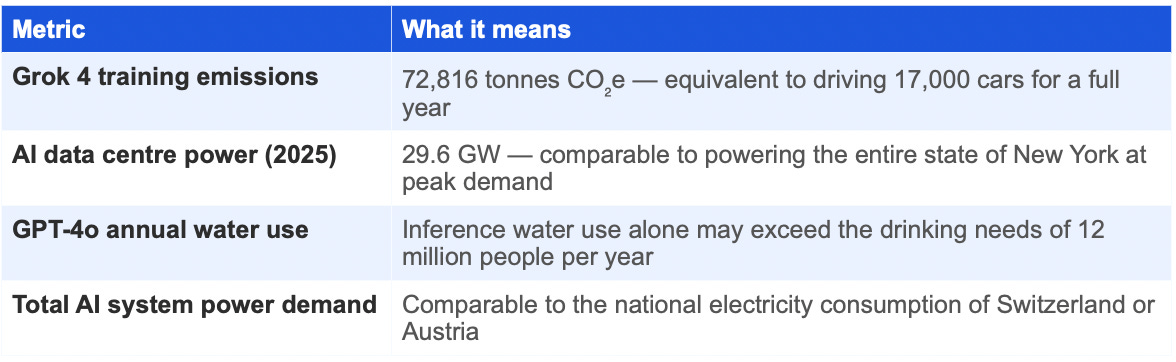
These are not edge cases or projections. They are documented impacts of AI systems that are already deployed and in use today. And as models grow larger and more capable, these numbers will grow with them. The report notes that efficiency improvements in hardware and training have not kept pace with the scale of new deployments.
What this means
‘Green AI’ is rapidly moving from a reputational concern to a regulatory and operational one. Boards and investors are paying attention.
Companies building on AI infrastructure should begin assessing their indirect environmental footprint now, not after regulators ask.
There is a growing market opportunity for energy-efficient AI solutions — this is a space worth watching.
5. What AI Still Cannot Do (Yet)
For all of AI’s remarkable advances, the 2026 AI Index offers a timely reminder that the technology has significant, sometimes surprising, blind spots. Stanford’s researchers call this the ‘jagged frontier’ — a term that captures how uneven AI capability really is.

Despite being able to win a mathematical olympiad and pass PhD-level science exams, frontier AI models still struggle with:
Telling time accurately in certain visual and contextual settings
Multi-step physical planning that humans find intuitive
Learning from video (as opposed to text or still images)
Generating long-form video that is coherent and realistic
Conducting nuanced financial analysis
Answering certain expert-level academic exams
What this means for you
Human common sense, physical dexterity, and embodied judgment remain genuine competitive advantages — for now.
Roles involving complex physical environments, nuanced interpersonal dynamics, and ambiguous multi-step reasoning are more resilient than often assumed.
The most powerful approach remains human-AI collaboration — each compensating for the other’s weaknesses.
The organisations and individuals who thrive in this environment will not be those who simply use AI tools. They will be those who understand AI’s capabilities and its limits, who invest in the human skills that complement it, and who help build the frameworks needed to govern it responsibly.
Are you treating AI as a search engine — or are you preparing for a world of digital coworkers?
That question is no longer theoretical.
All Sources & References
Stanford HAI — 2026 AI Index Report (full report, 423 pages)
Digital Information World — Stanford AI Index 2026 Report Details
Unite.AI — Stanford AI Index 2026: A Field Racing Ahead of Its Guardrails
Crypto.news — AI Jobs: Devs Under 26 Lost 20% of Work Since 2022
Analytics Drift — The Stanford AI Index 2026: Capability vs Trust
Thanks for reading. See you next week!
Let’s explore the future of technology together!
Disclaimer - The section “Stanford AI Index 2026 Report” was written with the help of Claude & Gemini. Let us know in case of any gaps
Your Turn:
Did you like the content? Share with your network. Subscribe now to get updates directly in your mailbox.